
I came across this competition called 1 minute to save the world when searching for current climate change campaigns:
"The Competition
A short film competition on climate change inviting entrants and viewers from all over the world. The story of climate change will be told by the people it is affecting - you. We hope that your shared perspectives and creative responses will help us all understand, adapt and take action in response to a rapidly changing world in time to save it and ourselves.
The Campaign
Advertisers and multi-nationals have long known the value of even just one minute of film. With the help of our international Partners we will use your entries as a platform to carry your voices far and wide in a global campaign for the planet rallying public and political support in the lead up to the Copenhagen Climate Conference and continuing until CO2 targets have been met. To take part all you need to do is creatively respond to the challenge of climate change using film as your medium.
We’re asking you to use whatever means you have to film your short and use your minute to speak up and make the world listen. We hope you will feel inspired to add your creative voice to this global climate campaign."
Details on the 2010 competition haven't been announced yet, but I think one minute of film is a good target, especially as I'll also be showing my film (s) at various festivals. My initial idea upon reading this brief was to combine all my cat storyboards into one, focusing on the impacts of flooding. An award was given for one of the films last year for most virally distributed. Surprise surprise its got a cat in it! See here.
After seeing that however, I know i can't do the same thing if I want to enter the same competition. I do like the idea of cats though, and they do boost viral viewings. Cats against climate change has had more than 300,000 views on YouTube and has appeared on the Viral Video Chart
Its one of only a few environmental videos that has gone viral. The main reason videos go viral is that they provide entertainment, if a video isn't entertaining, it won't go viral. Sometimes an exciting title can have an effect, like The Most Terrifying Video You'll Ever See it can lure an audience in, but the audience probably won't appreciate being cheated when they're expecting to be entertained. Some companies use marketing strategies to boost their viral viewings, its explained more in this article. I'm not sure I agree with all of their methods, but some things like posting my video on social networking sites could definitely be implemented.
Showing posts with label theories. Show all posts
Showing posts with label theories. Show all posts
Sunday, 7 March 2010

Friday, 19 February 2010
Ed Hooks- Acting for animators notes Part 1
Ed hooks, author of ‘Acting for Animators’ has a Stockpile of tips regarding how acting skills can be implemented into animation. If you can’t attend one of his master classes, I’d recommend you take a look at his book and sign up to his monthly newsletter, where you can read his craft notes on new releases.
----------------------------------------------
Stage actors work in the present movement, animators work in an illusion of the present moment, but the acting principles are the same.
Emotion and empathy
Ed Hooks describes emotion as an ‘Automatic Value Response’. While thinking tends to lead to conclusions, emotion tends to lead to action. Humans only empathise with emotion. Empathy literally translates as ‘Feeling into’ unlike Sympathy where the audience ‘feels for’ the character. While sympathy can work for short periods of time, ultimately you want the audience to relate to your character, that’s where empathy comes in. Ed had the example of the opening scene in ‘The Emperors New Groove’ to illustrate the use of sympathy where there should have been empathy. When a character stops making an effort to secure his or her own survival, the audience cannot empathise with them.

Empathy doesn’t work for characters you can control completely; it requires a certain amount of distance. In games when you have full control, you can’t empathise with the character. If it gets eaten by a zombie as it was you that made it happen. In The Sims however, the user has a certain amount of control but the characters ultimately have their own free will, their own personality, motives and reactions to your influences. The audience could feel empathy in the right situations. While they can take away all the windows and doors to a room, they cannot stop the Sim inside from crying or complaining of hunger. Read my review on The Sims 3 here.
Moving illustration vs. performance
Reality is very different from theatrical reality. In reality, you get 100% of everything, boring or not. In theatrical reality scenes are constructed for the purpose of telling a story, each scene has form.
If you can freeze frame a character at any given moment and understand what they are doing at that moment in time, then you have a good scene. Good performance is the following:

An action in pursuit of an objective, overcoming an obstacle
A character plays an action until something happens to make them play a different action. Obstacles= Conflict, there are three types:
• Conflict with self
• Conflict with a situation
• Conflict with a person
A child character mostly encounters conflicts with their situation, even if that involves another person. For example when Coralline wants to plant seeds in the rain and her mother doesn’t allow her to, this is conflict with her situation. Coralline, like most young children, accepts the authority of her mother so her conflict is with her situation, the rain outside more than anything else.
----------------------------------------------
Stage actors work in the present movement, animators work in an illusion of the present moment, but the acting principles are the same.
Emotion and empathy
Ed Hooks describes emotion as an ‘Automatic Value Response’. While thinking tends to lead to conclusions, emotion tends to lead to action. Humans only empathise with emotion. Empathy literally translates as ‘Feeling into’ unlike Sympathy where the audience ‘feels for’ the character. While sympathy can work for short periods of time, ultimately you want the audience to relate to your character, that’s where empathy comes in. Ed had the example of the opening scene in ‘The Emperors New Groove’ to illustrate the use of sympathy where there should have been empathy. When a character stops making an effort to secure his or her own survival, the audience cannot empathise with them.

Empathy doesn’t work for characters you can control completely; it requires a certain amount of distance. In games when you have full control, you can’t empathise with the character. If it gets eaten by a zombie as it was you that made it happen. In The Sims however, the user has a certain amount of control but the characters ultimately have their own free will, their own personality, motives and reactions to your influences. The audience could feel empathy in the right situations. While they can take away all the windows and doors to a room, they cannot stop the Sim inside from crying or complaining of hunger. Read my review on The Sims 3 here.
Moving illustration vs. performance
Reality is very different from theatrical reality. In reality, you get 100% of everything, boring or not. In theatrical reality scenes are constructed for the purpose of telling a story, each scene has form.
If you can freeze frame a character at any given moment and understand what they are doing at that moment in time, then you have a good scene. Good performance is the following:

An action in pursuit of an objective, overcoming an obstacle
A character plays an action until something happens to make them play a different action. Obstacles= Conflict, there are three types:
• Conflict with self
• Conflict with a situation
• Conflict with a person
A child character mostly encounters conflicts with their situation, even if that involves another person. For example when Coralline wants to plant seeds in the rain and her mother doesn’t allow her to, this is conflict with her situation. Coralline, like most young children, accepts the authority of her mother so her conflict is with her situation, the rain outside more than anything else.
Friday, 20 November 2009
Run Baboon Run!
I've been looking around a lot at video's of baboons running to see what movements I'd need for 'Mr Tibbles'. I've discovered that there are two main poses in their typical run-cycle.
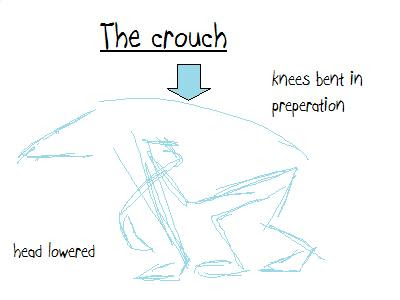
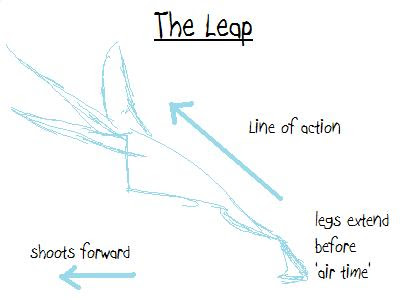
The major difference between a walk cycle and a run cycle in any character is that whilst running, there is a period of time where there are no limbs touching the floor. Essentially you hop from one spot to the other, shifting your weight from one foot to the other (or in the case of quadrupeds, jumping from the back legs to the front legs).
As with regular jumping, there is anticipation before the jump. This is the crouch, where the knees bend down in preparation for propelling the body forward. As the body shoots forward, the legs extend fully, pushing the rest of the body forwards and up. After this, there is a period of 'air time' where there are no limbs supporting the characters weight. The line of action is followed for a frame or two but then gravity takes hold, bringing the character back to the ground where there is a landing (arms first) in a pose that flows through to the crouch movement.
Generally when quadrupeds run, there is a slight offset between the movement of the limbs on the left and on the right. The faster they run, the lower the offset.
The faster the transition from crouch to leap and back again, the faster the animal will appear to run.
This baboon in an episode of Ren and Stimpy is so angry and is running so fast, that both poses merge together with virtually no in-betweens. While not a realistic approach, the humor and characterisation are benefited.


The major difference between a walk cycle and a run cycle in any character is that whilst running, there is a period of time where there are no limbs touching the floor. Essentially you hop from one spot to the other, shifting your weight from one foot to the other (or in the case of quadrupeds, jumping from the back legs to the front legs).
As with regular jumping, there is anticipation before the jump. This is the crouch, where the knees bend down in preparation for propelling the body forward. As the body shoots forward, the legs extend fully, pushing the rest of the body forwards and up. After this, there is a period of 'air time' where there are no limbs supporting the characters weight. The line of action is followed for a frame or two but then gravity takes hold, bringing the character back to the ground where there is a landing (arms first) in a pose that flows through to the crouch movement.
Generally when quadrupeds run, there is a slight offset between the movement of the limbs on the left and on the right. The faster they run, the lower the offset.
The faster the transition from crouch to leap and back again, the faster the animal will appear to run.
This baboon in an episode of Ren and Stimpy is so angry and is running so fast, that both poses merge together with virtually no in-betweens. While not a realistic approach, the humor and characterisation are benefited.
Sunday, 1 November 2009
It's all in the curves
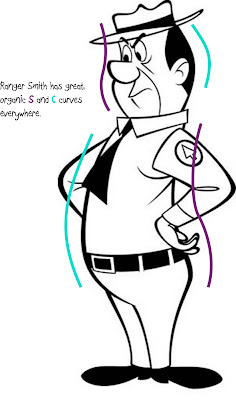
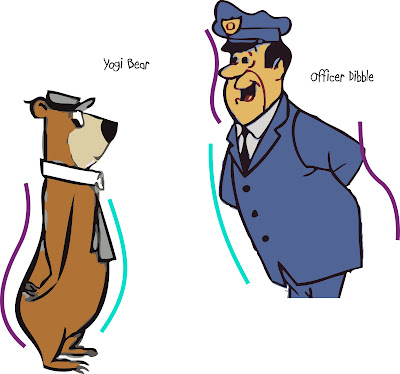
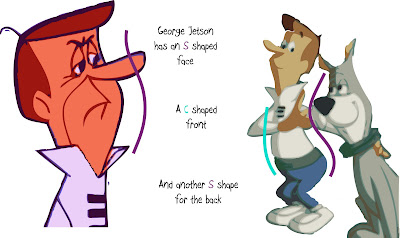
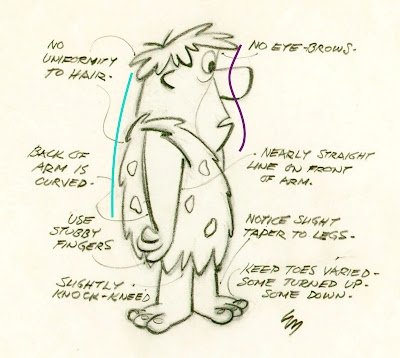
It's been noticed that a lot of characters in the 50's and early 60's (specifically male characters) have the same principles about them (I found this post to be very useful). I've been looking at character design in some of Hanna Barbera's human and humanoid characters and illustrating the basic curves that make up their construction. I want to apply the same Principle, organic curves to my Pete the Pet-Sitter character.


Wednesday, 21 October 2009
How to tell a joke
At the moment, I think my storyboard is far too long for the amount of time I have. I need to cut out anything unnecessary and keep in only what I need to get the point across. I read this article on how to tell a joke and found the folowing steps apply to my story the most:
Based on these principle steps, I can break my story down into 3 crucial parts giving me the principle three act structure.
Set up/ Begining:
Each part is crucial to a good joke and a good story. Without the set up, the punch line would make no sense, without the middle, the story would not flow, without the end, it wouldn't be funny.
#5 There must be ample set-up to the joke, providing the pertinent details the audience needs to know.
#6 There must be a punch line or strong conclusion.
#7 When in doubt, the shortest distance through Step #5 and onto #6 is usually best.
#8 Avoid detours. As a rule, jokes work best in a straight line.
Based on these principle steps, I can break my story down into 3 crucial parts giving me the principle three act structure.
Set up/ Begining:
- Man buys a baboon, is told not to touch it.
- Man touches baboon anyway
- Baboon goes crazy and chases the man
- Baboon catches man and touches him back, says "Tag you're it"
Each part is crucial to a good joke and a good story. Without the set up, the punch line would make no sense, without the middle, the story would not flow, without the end, it wouldn't be funny.
Thursday, 18 June 2009
12 steps to a healthy project
Looking back on past projects has helped me a lot with figuring out some sort of strategy/ pipeline that can be used for future projects.
Strategy
- Research: Gather as much information on the chosen topic as possible, and plenty of reference imagery, video, sound.
- Target audience: Choose a target audience that I want to focus on ad research as much as possible about them, look at past experiences when I was that age and draw from them.
- Objectives: Write a brief based on the target audience, or define a series of objectives from a brief that will define what I want to achieve and how I might achieve it.
- Treatment: What is the mood of the film? Decide on the look/ feel/ atmosphere/ genre, base this on the needs of the target audience.
- Story: Decide on the story (if there is to be one), I can get inspiration from anywhere as Miles McLeod emphasised. All I need to do is look.
- Script/ Storyboard: Refine the story and decide on the shots and 'camera' angles needed. Get inspiration from films and look at how they portray atmosphere/ hierarchy/ action/ emotion through the types of shots that are used and the speed at which it cuts. Remember what I defined in my treatment and objectives. Make the storyboard into an animatic and refine where needed.
- Design: Design a character (if there is to be one) that fits in with the design of the landscape and surroundings. Look at the work of other animators and artists to find a style that gives the effect I want and that I'm capable of animating in.
- Experiment: Test different techniques. Do they work? Do they fit in with the assigned timescale? Do they create the effect I was after?
- Reference: Create reference videos of the animation needed, test out my acting skills in front of a camera till I have good quality references for all the character animation.
- Animate: Substitute the animatic scenes for animated scenes as I progress, ask for feedback along the way by peers/tutors/online forums/professionals.
- Render/Refine/Edit: Make sure the final animation is of the best quality compression for the method of delivery. Is it for the web? For the big screen? Is there anything that needs improving before release?
- Reflect: Ask for feedback from everywhere the film is shown, wherever that may be. Learn from any constructive criticism.
Sunday, 10 May 2009
Villans
The presence of an antagonist is essential in most stories and it can manifest in many ways. Often in children's animation the antagonist is so obviously a villain in his appearance that we need not know their crimes to believe they must be evil. It helps of course when the villain does act in a way to scare or otherwise cause harm to the protagonist. It helps induce, not strictly fear, but anticipation and excitement in the audience and they follow the story with renewed interest as to what will happen to the hero next.
In the Looney Tunes cartoon 'Hyde and Hare', an adapted story of Dr Jekyll and Mr Hyde, bugs is fearful of Mr Hyde without knowing that he is also Dr Jekyll. The cartoon uses the classic pantomime technique of having the audience know more than the protagonist; a case of 'He's behind you!' This engages the audience further than the fear and excitement alone, having the audience on the edge of their seats wishing Bugs would realise what we already know.

One of my favourite illustrations of the theory that a villain need only to look like one to be believed as one, is in 'Transylvania 6-5000' again another Looney Tunes cartoon based loosely around a classic tale. The house itself screams dark and evil but Bugs seems none the wiser. Again its another case of the audience knowing more than the protagonist. The vampire character seems born from the shadows, simply a vague black mist floating along till he appears suddenly tall and with feed on the ground in front of Bugs. This is a clever animation technique as well as an effective one. Why have a character walk when he can float mysteriously over the ground?

 The eyes are also important in the way a character is perceived as evil, typically the pupils are small and the eyes are narrow, as if in a glare, for many of the character's expressions.

In the Looney Tunes cartoon 'Hyde and Hare', an adapted story of Dr Jekyll and Mr Hyde, bugs is fearful of Mr Hyde without knowing that he is also Dr Jekyll. The cartoon uses the classic pantomime technique of having the audience know more than the protagonist; a case of 'He's behind you!' This engages the audience further than the fear and excitement alone, having the audience on the edge of their seats wishing Bugs would realise what we already know.

One of my favourite illustrations of the theory that a villain need only to look like one to be believed as one, is in 'Transylvania 6-5000' again another Looney Tunes cartoon based loosely around a classic tale. The house itself screams dark and evil but Bugs seems none the wiser. Again its another case of the audience knowing more than the protagonist. The vampire character seems born from the shadows, simply a vague black mist floating along till he appears suddenly tall and with feed on the ground in front of Bugs. This is a clever animation technique as well as an effective one. Why have a character walk when he can float mysteriously over the ground?

 The eyes are also important in the way a character is perceived as evil, typically the pupils are small and the eyes are narrow, as if in a glare, for many of the character's expressions.
Thursday, 7 May 2009
First Ideas
FEAR, irrational, self induced, rational, elevated by peers or siblings, nightmares and monsters under the bed.
At the age of 7 most children have at least one fear, sometimes many more. Some children are more prone to getting scared than others, fear can thrill some and terrify others. Though I didn't have a fear as such, once I knew what another child's fear was, I would tend to scare them with it, making up stories and confronting them with things that scared them, like with my sister and spiders. It was a little cruel, yes. I guess I just found it funny that others could be scared so easily.
It would be interesting to do a story on an older sibling (like I am) scaring a younger one, but working himself up till he started to believe the stories he told were true.
Or perhaps a small child who confronts the monster under the bed and tries to make friends. A story about conquering fears and overcoming irrational thoughts.
Media

I don't remember much about the things I used to watch at that age. I think it was probably because I didn't watch a lot of TV, I made my own entertainment, played with my barbies, read books, painted, drew or made dens. I liked cartoons though, catching them after school or on weekend mornings. My favourites were old favourites, the Loony Tunes and Tom and Jerry. I remember running downstairs whenever the theme tune came on for the Loony Tunes, excited by the prospect of another fun short where animals talked and bunny rabbits outwitted sneaky hunters in very funny ways. I also liked the Pink Panther, another smart animal that made humans look hilariously stupid. Of course I had no Idea at the time that these cartoons were ages old and just happened to be repeated occasionally when I was growing up, I only knew that I liked them a lot.

I do remember more recent cartoons, such as 'The animals of farthing wood' which were nice but they didn't interest me as much, I liked the animals, and the fact that they talked, but they were still to real I guess, not interesting enough, they weren't funny enough. And after watching Watership down, a film so similar in its style to the animals of farthing wood, I could never go back to it. The rabbits die!
When it came to films I was open to anything with animals in it there seemed to be a lot with talking rodents, The secret of Nimh, Fifel goes West, The Rescuers, The rescuers Down Under, American Tail. I guess it must have been a craze or something at the time, but I loved them. I also loved anything that Disney made. We used to go to the video shop up by my school with a huge array of kids films. We watched them all, my sister and I, at least one a week.

We didn't have a PlayStation till they were cheap enough for me and my sister to go halves with our birthday money and buy one for £100 from that same video shop as the owner began introducing games. I was around 8 or 9 then I think so I won't go on with that. We did have a computer though, I'm sure at that stage. A really old DOS model with no mouse, only a keyboard. Games came on floppy disks and everyone in the household was addicted to lemmings at one stage or another.

I think 7 year olds now would be more in tune with media entertainment than I perhaps was at that age. Of course Barbies still exist and I used to play with those, but I liked setting up their houses rather than actually playing houses with them. I would make Items of furniture for them, dress them up and decorate the rooms but had little desire to actually act out anything with them. I preferred life sized roleplay even if it was the fantasy 'ebwa' world, I could pretend I was something else. I also loved to dress up, we still have the fancy dress costume today, full to the hilt with ex charity shop goodies that me and my friends would dress up in and be whatever we wanted to be, princesses, space explorers, witches, monsters... anything. We'd perform plays or puppet shows that we'd invented for the adults to watch. I tended to choose social fun and interaction while at home rather than be stuck in front of the TV or computer. It seems times have changed, screens have got bigger, more colourful, less static and with better quality sound and picture- theres more now that will pacify an active child with all the bright colours and theme tunes like sirens.
Subscribe to:
Posts (Atom)